

Heart Intelligence
At the crossroads of the 'new human' vs 'trans-humanism'

~ Creator said ~
“I want to hide something from the humans until they are ready for it. It is the realization that they create their own reality.”
The eagle said,
“Give it to me. I will take it to the moon.”
The Creator said, “No. One day they will go there and find it.”
The salmon said, “I will bury it on the bottom of the ocean.”
The Creator said, “No. They will go there, too.”
The buffalo said, “I will bury it on the Great Plains.”
The Creator said, “They will cut into the skin of the earth and find it even there.”
Grandmother who lives in the breast of Mother Earth, and who has no physical eyes but sees with spiritual eyes, said “Put it inside of them.”
And the Creator said, “It is done.”
― Creation story from the Hopi Nation, Arizona...
This topic has many layers and - as the subtitle suggests - it is my view and my rather bold statement that Heart Intelligence, achieved through the practice of Heart Coherence, holds the key to humanity’s current transformative leap in evolution.
One of the layers talked about here will be the use - or misuse - of AI and why now, more than ever, the wisdom, knowledge, information and ‘truth’ about our heart is so important or even urgent.
So read on, click the links to explore the resources mentioned here and travel with me on this journey into the heart. A journey which, like the story at the beginning, can be found in Hindu, in Sufi, in Hopi and even in Christianity (the ‘divine spark’).
If you are keen to find out how to
improve mental functions like focus, clarity, memory, big picture thinking
tap into your own intuition and trust your inner wisdom
increase physical coordination, improve reaction times
gain hormonal balance, a healthier immune response, improve sleep, digestion
be a loving, caring, compassionate parent, a partner, a leader, co-worker, friend…
then this substack post will hopefully help you and point you in the right direction.
My own Heart Coherence Story
About 20 years ago, I was living in Hong Kong at the time, I was in the midst of training to become a coach and therapist. In one of my trainings my trainer introduced me to a tool, a software that connects to my laptop and just like that I had begun to practise heart coherence. Back then the software was called Freeze Framer, developed by the Institute of Heartmath. It was later upgraded to emwavePRO. I have since literally used it with friends, family and with nearly all of my clients. I have presented it to groups, and held regular “Heart Coherence” meditations in various sized groups.
From an original background as translator and interpreter a whole new world was about to open up for me - and my family. Through my Hong Kong International Coaching Community I had formed new friendships, met Judith Deloizier and attended Anita Moorjani’s first presentation on her near death experience at the Hong Kong Polytechnic. I had become a registered provider for “The Harrison Assessment” which I was hoping to introduce to our new home country, New Zealand.
Well, life has its quirky ways to present itself, let’s say it that way.
I feel that I myself, but also we all as humanity, are in a similar phase to back in 2005-2007 and I know one thing for sure: having learned about Heart Coherence and having the main component always with me - my heart - it is the most important, and yet very simple, practice to get into.
Heart Coherence vs AI
In a recent podcast, former Google X executive Mo Gawdat talks about his ‘change of heart’ after the death of his son Ali. He sees that Tech and AI haven’t kept the promise of ‘connecting people’ but rather have separated us. His view about AI is that it reflects what humanity shows it, so if we don’t ‘grow up’ it will manipulate, act with envy and greed and so on. Mo’s podcast really is lovely to listen to, don’t miss out on it. His idea is to spread ‘happiness’ from one person to the next and we will soon reach millions of people - and AI will learn from THAT.
To place even more urgency on the matter, and to emphasise how AI is taking humans to the polar opposite of what heart intelligence can mean for humanity, I want to point to a 2025 study at MIT, involving 54 students and giving them the task to write an essay. The students were divided into three groups, one was using ChatGPT in their writing, one group was assisted by Google and the third group wrote the essay without any of the ‘tech’ support. The findings are astounding and highly alarming, when it comes to the human brain!
Reduced Brain Activity:
ChatGPT users showed the lowest brain activity, particularly in areas associated with memory, creativity, and focus.Poorer Recall:
ChatGPT users struggled to recall information from their essays, indicating a potential "cognitive offloading" effect.Lower Quality Essays:
Human and AI raters assessed essays written with ChatGPT as having weaker arguments and poorer quality compared to those written without AI assistance.Convenience vs. Cognitive Cost:
While AI tools reduced the effort required to find information, this convenience came at the cost of decreased critical thinking and evaluation of the information.Potential for Decreased Diligence:
The study also noted that ChatGPT users tended to become less diligent over time, often resorting to copy-pasting the AI's output without significant editing.Impact on Brain Connectivity:
The study highlighted that those relying on ChatGPT from the outset exhibited the lowest connectivity in brain regions associated with executive function and deep memory processing.
The term ‘cognitive debt’ has since been discussed in many circles, the fact that the brain’s decline couldn’t be reversed!
And here is where Heart Coherence becomes THE KEY and, yes, I’d like you to shout it from the rooftops.
The Institute of HeartMath (heartmath.com and heartmath.org) defines heart coherence as “a healthy measurable state, cooperative alignment between heart, mind and emotions”. Coherence is a state that ‘regenerates us’, where emotional balance is found, stability and improved mental functions. It is also where we access our intuition.
Neuro-cardiologists have made an exciting discovery these last decades: The heart has its own independent nervous system referred to as the ‘brain in the heart’. This nervous system in the heart sends signals to the brain, to the amygdala (there’s one in each brain hemisphere actually), the emotional processing centre, to the thalamus, where cortical functions take place and to the higher brain centres, where clarity of thought etc happens.
As much as the brain does send information to the heart it is now known that there is a lot more information being sent from the heart to the brain!
We now know that the heart is not a pump but rather blood flows in an out of the heart in a spiral vortex. The heart informs every cell in our body, sits in a 36degree angle, has a fifth chamber with piezoelectric qualities - the esoteric heart - where our heart flame resides. Professor Mae Won Ho studied the electric voltage of the heart and found it to be 60 times greater than that of the brain.
The heart creates a torus shaped, 1.5m big heart ‘field’ where we connect with other human beings, or with their heart fields. The field’s magnetic component is 100 - 5000 times stronger than that of the brain.
In case you don’t notice let me point out that the 1.5m was also the ‘social distancing’ figure during the ‘C’ time. Thoughts on that?

In a heart-coherent state - some buddhist monks naturally achieve this in their meditations - we can reach a ‘gamma brainwave state’, a state were healing occurs, a state that I have heard being called “Shante Ishta” in Sanskrit, or the “single eye of the heart”.
For all the research done by the Institute of Heartmath I recommend to dive deep into their resources here https://www.heartmath.org/research/
Here’s a fun game to play: try and find as many phrases in your native language that include the word ‘heart’. You know sayings like “I’ve learned it by heart” or “I’m having a heart to heart with someone” or “my heart is wide open” and who hasn’t experienced the “broken heart”?
I’ve linked an interesting TED talk here below, which if you’ve ever experienced heart ache, panic, suspected heart attack only to be found at your doctor’s having absolutely no problem, this talk might explain why.
TED Talk by Sandeep Janhar, Heart Specialist
Takotsubo cardiomyopathy, The Broken Heart Syndrome
There is a heart disorder first recognized about two decades ago called "takotsubo cardiomyopathy," or "the broken heart syndrome," in which the heart acutely weakens in response to intense stress or grief, such as after a romantic breakup or the death of a loved one. As these pictures show, the grieving heart in the middle looks very different than the normal heart on the left. It appears stunned and frequently balloons into the distinctive shape of a takotsubo, shown on the right, a Japanese pot with a wide base and a narrow neck. We don't know exactly why this happens, and the syndrome usually resolves within a few weeks.
However, in the acute period, it can cause heart failure, life-threatening arrhythmias, even death.

Heart Intelligence and our Intuition
Many years ago when I first read up about ‘heart intelligence’ I came across a research that sparked my passion for this topic. I’m sure it would be easy to find on the internet, I’m writing about it as I have recalled it and shared with many friends and clients these past decades.
The research involved blind-folded people to walk barefoot on a floor with randomly place ice cubes. Similarly another group was shown random images on a screen, some lovely, beautiful images and some random ‘shocking’ images. EEG and HRV were measured and the amazing readings showed that a fraction of time BEFORE an ice cube or a shocking image there was a spike in the heart rhythm!
In a global coherence project similarly it is shown that BEFORE significant events the human family’s collective heart rate variability experiences a spike.
Amazing, right?
Trauma and HRV
Having been involved in trauma recovery in the 2010/2011 Christchurch earthquakes, witnessing first hand and at the frontline what works - and what doesn’t - I will dedicate a whole chapter or article on this substack to summarise my findings and personal experiences. For the purpose of this topic of Heart Coherence, Heart Rate Variability (HRV) and Heart Intelligence I want to mention one of the many scientists who approach trauma recovery in a very new way.
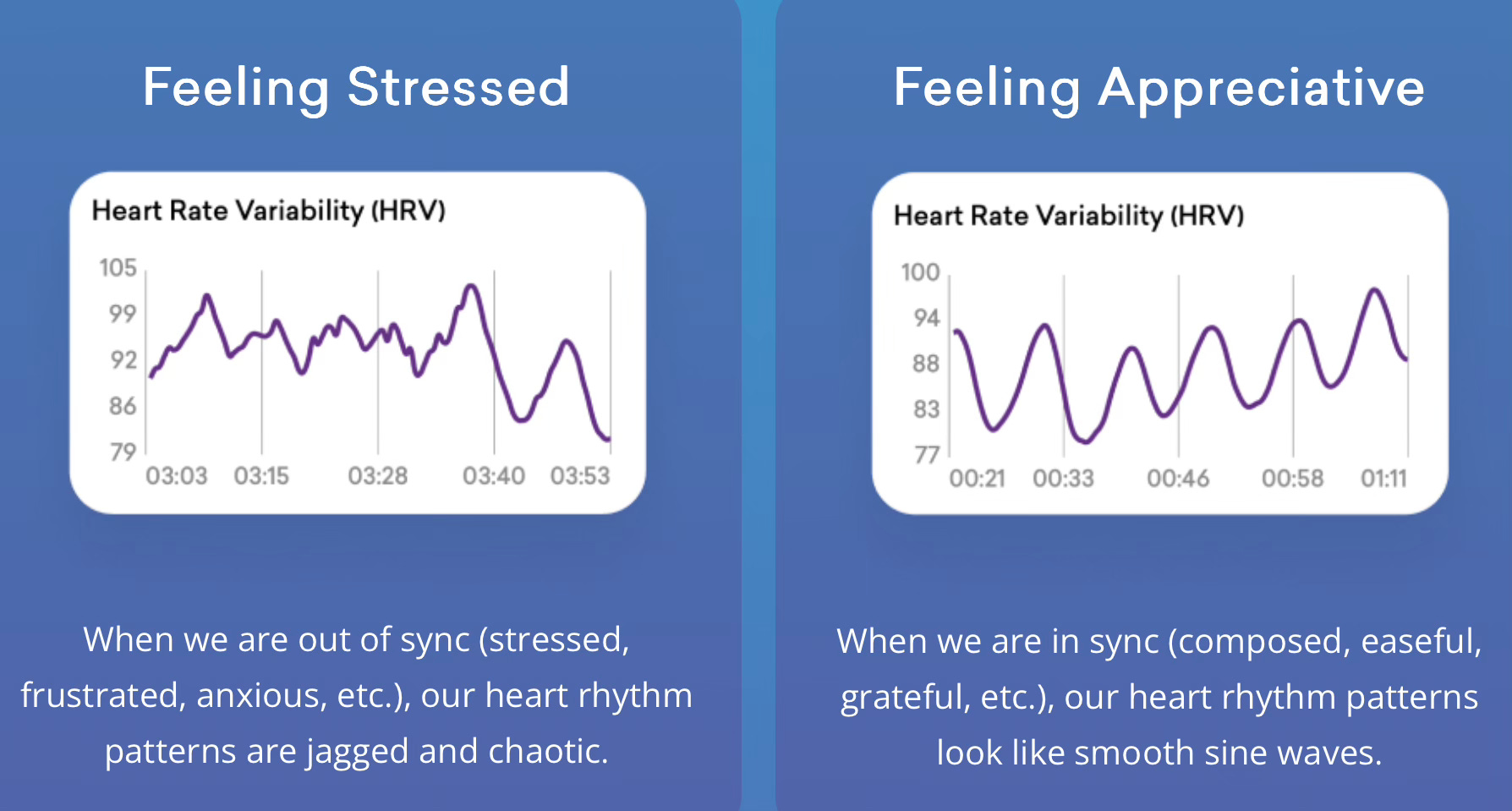
Bessel van der Kolk uses heart rate variability (HRV) to assess nervous system health, with low HRV indicating stress and poor autonomic nervous system (ANS) regulation, a common symptom in PTSD. His work in "The Body Keeps the Score" explains how trauma can lead to rapid, shallow breathing and reduced HRV, making it hard for the body to shift between fight-or-flight and rest states.
HRV as an indicator of nervous system balance:
HRV measures the balance between the sympathetic "fight-or-flight" system and the parasympathetic "rest-and-digest" system.
Low HRV in trauma:
Individuals with PTSD often have low HRV, showing a lack of variability and shallow breathing patterns that are not synchronized with the heart rate. This suggests a dysregulated nervous system that struggles to shift between states of high and low arousal.
Rest and recovery:
High HRV reflects good health and the ability to balance the ANS, which is essential for well-being.
Before getting into a simple exercise for you to begin your Heart Intelligence journey, I want to get back to what I wrote about earlier, namely about the heart’s shape, its position in our body - and had I mentioned that it is also the VERY FIRST signal you get when an embryo is first formed (not that I would encourage the use or over-use of ultrasound!), that it isn’t a pump. On my search for more concrete evidence for this I came across an interesting researcher by the name of Frank Chester. I shall link to one of his presentations and you may pursue this trace yourself, as it may become too much information for the purpose of this article.
Frank Chester “Chestahedron” joined two Platonic solids to form a ‘Chestahedron’ and in below video he is entering a conversation about a “New Vision of the Heart”
Chestahedron - A new vision of the hear
Let’s together finish this off with a little heart coherence exercise, Heartmath’s Quick Coherence® Technique. I’ll link the video to Deborah Rozman’s YouTube video.
Create a coherent state in about a minute with the simple, but powerful steps of the Quick Coherence® Technique. Using the power of your heart to balance thoughts and emotions, you can achieve energy, mental clarity and feel better fast anywhere. Use Quick Coherence especially when you begin feeling a draining emotion such as frustration, irritation, anxiety or anger. Find a feeling of ease and inner harmony that’s reflected in more balanced heart rhythms, facilitating brain function and more access to higher intelligence.
Step 1: Focus your attention in the area of the heart. Imagine your breath is flowing in and out of your heart or chest area, breathing a little slower and deeper than usual.
Suggestion: Inhale 5 seconds, exhale 5 seconds (or whatever rhythm is comfortable.)

Step 2: Make a sincere attempt to experience a regenerative feeling such as appreciation or care for someone or something in your life.
Suggestion: Try to re-experience the feeling you have for someone you love, a pet, a special place, an accomplishment, etc. or focus on a feeling of calm or ease.
I usually place my hand(s) on the area of my heart (diaphragm), keep both feet grounded, legs uncrossed. It does work much better when I am connected to the Heartmath programme on my computer. At times, especially after some big events in our lives, we may have to re-learn our own personal Heart Coherence. Good news: it comes back really quick - and is SO worth doing.
Thank you for reading thus far, for your interest and for your time spent with me here.
I read a community post on social media last week, where someone was crying out for help with mental health issues, but couldn’t get an appointment anywhere. He was recommended by 2 community members to use ChatGPT to help him with mental health issues …. everything in me just screamed ‘Nooooooooo’!!! I’ve by now heard too many stories, real horror stories about how a non-empathetic Large Language Model has given exact suicide instructions, precisely copied the last narcissistic abusive partner etc etc. So, no, involving AI in your mental health hygiene is not the way to go. Let’s get back to Mo Gawdat’s advice, imprint our field with plenty of good human qualities, seek and sustain that connection to self and others and become the best humans this world has ever seen.
Thank you, much love,
Barbara
Beautiful Barbara, I felt really moved reading your piece and send you are speaking about a really important resource we all have within us. An open heart is a gift to the world. ♥️